Showing posts with label Japanese Culture. Show all posts

Tuesday, July 17, 2018

Seasonal Sodas

There have been a few interesting limited-edition sodas released this spring and summer, and I've finally gotten around to tasting of all of them. Coca-cola released a peach coke this spring and followed up with a clear coke this summer. Pepsi has released a line of J-Colas, as they're called, with Japanese art on the label. This line includes J-cola, J-Cola zero, and J-Cola midnight which has a currant flavor.

Peach Coke


This tastes exactly as it sounds. It's definitely coke, but with a really strong peach scent and flavor. I found it kind of overwhelming, and not exactly an improvement, but definitely interesting to try.

Clear Coke


I was in elementary school when crystal pepsi came out, and I remember how excited I was when my mom let us buy some - we rarely got to have sodas. I was way to young to remember how it tasted, but I liked to imagine it was similar to this Clear Coke. This is a zero calorie soda, which I don't mind, but it does that artificial sweetener flavor. It also tastes lemony, and has a strong caramel flavor which was strange since it obviously doesn't have any caramel coloring. John thought it tasted like Sprite, but I disagree.

J-Cola 


John thought this tasted a lot like Dr. Pepper, which is interesting because Japanese people tend to hate the flavor of Dr. Pepper. I thought it was fine, but just tasted like any old cola. I also tried J-Cola zero, and couldn't really tell you how it's different from Pepsi's other zero calorie soda. But not bad.

J-Cola Midnight


This one was really hard to find - we actually didn't see it until we were on vacation in Hokkaido. J-Cola midnight is a cola with cassis (black currant) flavor added. I actually thought it was really good. The cassis is fairly prominent, but blends into the cola flavor very well.


Tuesday, July 10, 2018

Summer Vacation

A few weeks ago John and I took a spontaneous summer vacation! We decided to go up to Hokkaido, the northernmost island in Japan, for the first part of the week, and then pop down south to Kyushu for the final weekend of our trip.

Hokkaido was wonderful, much cooler than the hot humid weather Tokyo has been having, and with lots of wide open outdoor spaces. Our first stop was Noboribetsu, a small onsen town that's famous for its volcanic sulfur vents and geysers. After a night there we went to Sapporo, the biggest city in Hokkaido for several days, and then went out to Otaru and Yoichi. Otaru is a small port town with a lovely canal and old western style stone buildings. And Yoichi is the home of a major Japanese whiskey distillery. We really enjoyed seeing it all, and also relaxing, lying around reading, and spending time in coffee shops.

Fukuoka, the biggest city in Kyushu, reminded us a lot of Tokyo but moved at a much more casual pace. In one ramen shop (that is very famous and had a line out the door) we were told to take our time and enjoy our meal! At ramen shops in Tokyo you are expected to eat as quickly as possible and get out, so it was quite a pleasant surprise.

Both Sapporo and Fukuoka are know for ramen - miso up north, and pork broth in the south, and we ate our hearts out. We liked everywhere we went except for one place. Quick tip - if you find yourself in Sapporo, Yukikaze was incredibly good! And if you find yourself in Fukuoka we thought Issou did not live up to the hype.

Sulfur vents in Noboribetsu

John bought me this adorable coke

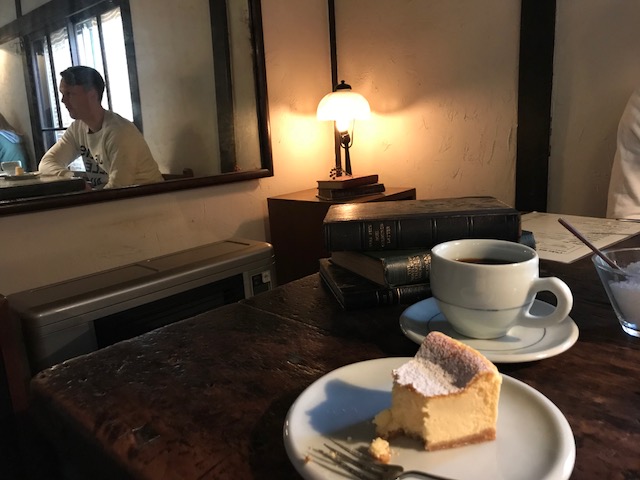
Coffee and cheesecake, plus John in the mirror

Our hotel in Sapporo had a fire pit on the roof

The old Sapporo brewery

Yukikaze ramen - so delicious!

Yoichi is old-fashioned and uses direct fire stills

Yoichi distillery

The canal in Otaru

Drinks on the beach in Kyushu

Fukuoka at sunset

If you're not having cake for breakfast you're not doing vacation right

Monday, November 27, 2017

Oedo Onsen Monogatari

Oedo Onsen Monogatari in Odaiba has been described as an onsen theme park. I found that description really off-putting, so for years I avoided going. But this year I finally went with a group of friends, and I actually really enjoyed it.

First things first, it's a little more expensive than other onsen I've visited, and it feels a little less authentic. That said, I didn't think that negatively impacted my experience. This is an excellent option if you don't speak Japanese and/or it's your first time and you don't have anyone with onsen experience to go with. The staff can speak English (and I presume Chinese), and they are good at managing large groups. Tour buses often drop groups off, but it doesn't make the facility seem crowded or slow things down unnecessarily.

When you arrive, you immediately remove your shoes and leave them in a shoe locker. Then you go to the front desk and get a wristband that opens a locker and allows you to charge food, drinks, souvenirs, and various spa treatments to your tab. Next you're issued a yukata (cotton robe) and sent to the changing rooms. This is where things diverge from normal a little bit, though it's not that different from other spa-style onsen.

After changing into your yukata you enter an area that is themed like an old Edo village. It's actually very cute. There are lots of places to eat and buy souvenirs, and from here you can access the spa where you can sign up for different massages and treatments. This entire area is mixed sex, so if you're with a group you can hang out with everyone. Then when you're ready, you can head to the separate baths. In the second locker room you will be given towels, and get yet another locker (there are lots of keys to juggle) to change out of your yukata.

There are a nice variety of indoor and outdoor baths, and it's all very clean and beautiful. I will say that I've been twice now, and each time my skin smelled like chlorine after leaving. I suspect they are treating the water. This is not typical of onsen, but I suspect it is a cleanliness precaution taken because with a high volume of tourists it's possible people will make mistakes with the usual washing procedure. I did not notice any chlorine smell when I was actually in the baths, and I have a very sensitive nose, so I think it's probably quite mild. It shouldn't detract from your experience.

Afterwards you can put your yukata back on and return to the communal area if you'd like to eat, shop or rest more. If you're looking for a place to eat I highly recommend Yamagishi Taishoken. It's a branch of a very famous ramen shop that is credited with creating and popularizing tsukemen (dipping noodles). 

This is a really accessible onsen, and I really appreciate that fact. But if you're looking for something that feels a little more "deep Japan" Sayanodudokoro Onsen, Utsukushinoyu, or Spa EAS might be more what you're looking for.

Oedo Onsen Monogatari
Hours: 11:00 am - 9:00 am, last entry at 7:00 am Mon-Sun
Phone: 03-5500-1126
Address: 2-6-3 Aomi, Koto-ku, Tokyo
Map

Oedo Onsen Monogatari

The Edo style village
Lots of great photo ops

Yamagishi Taishoken Ramen and Tsukemen

The noodles are SO good!

Tuesday, October 31, 2017

Beppu Getaway

Over the summer I took a short trip to Beppu, a hot spring resort town in Kyushu, with my friend Nicola. I can't believe it's taken me so long to write about it, but it was such a refreshing break from Tokyo. The scenery was beautiful, the food was delicious, and I never say no to a good onsen.

Before we left I had trouble finding very much information about the area in English. My old paper Japan guidebook doesn't even mention the town! I'm going to go a little heavy on details and photos, so brace yourselves. 

The biggest draw in Beppu is definitely the hot springs, and for the most part that means onsen, but there are also jigoku or "hells" - hot springs so hot they are meant to be viewed rather than bathed in. There are 7 jigoku, and you can easily take a bus to all of them, but we had the luxury of renting a car and going at our own pace because Nicola has a Japanese drivers license! Each jigoku charges 400 yen admission, or you can buy a 2000 yen pass that grants admission to all. The entire tour can be done in just a few hours, so I'd recommend doing all of them. If you're pressed for time though, Umi Jigoku and Onishibozu were the two most beautiful in my opinion. Additionally, Oniyama Jigoku breeds crocodiles - apparently they like the hot water - but we found it kind of cramped and depressing. Definitely skippable.

Of course, what I was really excited about were the onsen. But be forewarned, the waters in Beppu are hot! The onsen where we stayed was so hot that neither Nicola or I could actually get in the water. Several Japanese guests looked at us like we were insane as we yelped and leapt out of the water. But they did the same thing when they tried to get in, and then agreed with us that it was shockingly hot. After that experience I decided to go to Hyotan onsen, which is a big onsen complex geared towards tourists. I was excited that it included the chance for a hot sand bath, and because I thought it was most likely to have at least some water that was a tolerable temperature. Good news - I soaked in all the baths, and none of them were too hot for me.

While we were in Beppu we decided to drive out to Yufuin, another hot springs town nearby. I think it has a reputation of being a little fancier and more sophisticated than Beppu. In any case, it was beautiful. It has a main shopping street filled with food and shops like many tourist towns, and if you follow that road far enough it ends at a pretty lake. Yufuin is also known for dairy production, so there are all sorts of ice creams, cheese cakes, and other delicious treats available.

I feel silly admitting this since I've lived in Japan for so long, but this trip was the first time I've ever stayed in a ryokan. A ryokan is a traditional Japanese inn with tatami (woven straw) floors, futon mattresses on the floor, and communal baths. Ryokans can be fabulously luxurious, but ours was definitely no frills. It's also common to eat breakfast and dinner at a ryokan, but we did not. I was surprised by how comfortable the futon was, but this was definitely a place to sleep, not to linger.

Nicola and I were both surprised by the size of Beppu and the main shopping streets. We'd worried there wouldn't be many restaurants, particularly open on Sunday night, but there were plenty of options within a short stroll of our ryokan. Our top recommendations are Genova, an awesome takeout ice cream shop, Torisutei Honten, a yakitori (grilled chicken) restaurant, and Kihei Cafe, an adorable coffee shop with a delicious breakfast. We also had delicious burgers in Yufuin at Yufuin Burger, and you can't go wrong with any of the ice cream in town.

Our little ryokan room

Steam vents and structures are visible throughout Beppu
The grounds of Umi Jigoku

Umi Jigoku

Girls' Trip


Oniishibozu Jigoku


Shiraike Jigoku

Chinoike Jigoku


Tatsumaki Jigoku

Delicious burgers

Yufuin

You can see steam billowing up in the mountains

Cheesecake ice cream

The drive to Yufuin is gorgous

Genova Ice cream
Hours: 3:00-Midnight Mon-Sat, 3:00-10:00 Sun
Phone: 0977-22-6051
Address: 1-10-5 Kitahama, Beppu, Oita
Map

Yufuin Burger
Hours: 11:00-5:30, closed Wednesday
Phone: 0977-85-5220
Address: 3053-4 Yufuincho Kawakami, Yufu, Oita
Map

Torisutei Honten
Phone: 0977-22-3787
Address: 1-15-11 Kitahama, Beppu, Oita
Map

Kihei Cafe
Hours: 8:00-6:00,
Phone: 0977-23-1134
Address: 6-30 Fujimicho, Beppu, Oita
Map

Hyotan Onsen
Admission: 750 yen, sand bath additional 330 yen + towel rental
Hours: 9:00 am - 1:00 am
Phone: 0977-66-0527
Address: 159-2 Kannawa, Beppu, Oita
Map

Nogamihonkan Ryokan
Phone: 0977-22-1334
Address: 1-12-1 Kitahama, Beppu, Oita
Map

Monday, October 16, 2017

Yokohama Cup Noodle Museum

Last fall I visited the Cup Noodle Museum in Yokohama. That's right, Yokohama not only has a ramen museum, they also have a museum dedicated to instant ramen!

The first thing we did upon arrival was watch a brief movie about the man who created instant ramen. The movie is in Japanese, but you can get a headset with English, Korean or Chinese audio. I thought the movie was cute and had a sweet message about never giving up, which was a theme throughout the museum. It evidently took Mr. Momofuku many tries before he succeeded in creating instant ramen.

Afterwards there is a model of the shed Mr. Momofuku worked in for so many years, a room full of the many different iterations of Cup Noodles and other Nissin brand instant ramen, and some entertaining ramen themed art work.

But the highlight of the visit is the opportunity to create your own cup of noodles for 300 yen. First you are issued a cup and seated at a table with markers to decorate it as you please. Once your cup is ready to go, you can select a broth flavor and your favorite toppings and watch as the cup goes through the assembly line. To be honest, I thought it sounded a little gimmicky, but it was really fun. Depending on how busy the museum is you may be able to make two or three cups if you like, but I've heard of it being limited to one on some days.

Of course, at the end there is a huge gift shop if you need even more than your individualized Cup Noodle to remember the day.

Admission: 500 yen
Hours: 10:00-6:00, no entry after 5:00, closed on Tuesday
Phone: 045-345-0918
Address: 2-3-4 Shinko, Naka-ku, Yokohama


So many years and varieties of Cup Noodles


Sunday, September 10, 2017

Akasaka Palace

Last weekend John and I went for a walk and happened to wander by Akasaka Palace. From a distance we noticed that the gates were open, so we went closer to investigate. It turned out that they were open for tours, so we jumped at the chance. Through 2015 Akasaka Palace was open to visitors for only a few days each year, but starting last year they have increased the number of days they're open to the public.

Akasaka Palace was built in 1909 in neo-Baroque style. It was quite surreal to walk through the building as it felt so thoroughly European. Sadly, no pictures are allowed inside, but it's stunningly beautiful. Today the palace is used as a guest house for visitors of state.

If you're on vacation this is definitely not a must-see. But if you're in Tokyo for a while it's a really interesting departure from other sites. We probably wouldn't have made plans to tour the palace, but really enjoyed the opportunity when it fell into our lap. I'd definitely recommend it. Their fall schedule is available here.


Akasaka Palace
Hours: See Schedule
Admission: Gardens - free, Main Building - 1000 yen
Map

Friday, June 23, 2017

What I've Been Cooking Lately

It's been a while since I've posted about my cooking, but I feel like lately it's been worth mentioning. With the warmer weather there's so much summer produce already available - peaches, cherries, corn on the cob. I enjoy those all so much more now that they're only available during a specific season. I've also been trying out a few Japanese recipes here and there. It might be a terrible excuse, but I rarely cooking Japanese food because it's so readily available, and I always think that nothing I could make would taste as good or be as authentic. But the last three recipes I tried all came out really well!

Oyakodon - Chicken and Egg Rice Bowl

Fancy Brunch - Recipe from Smitten Kitchen

Gyudon - Beef and Sweet Onion Rice Bowl

Shiso Pasta - Shiso is a Japanese herb with a flavor similar to mint and basil

Prosciutto and Cherry Salad - Recipe from My Little Expat Kitchen
The Japanese dishes come from Japanese Soul Cooking.

See other JSC recipes:

Yakiudon
Mabo Dofu
Sapporo Soup Curry
Sesame Karaage
Omurice
Tan Tan Men
Pork Gyoza
Ebi Chili
Japanese Soul Cooking Review